PGP encrypt
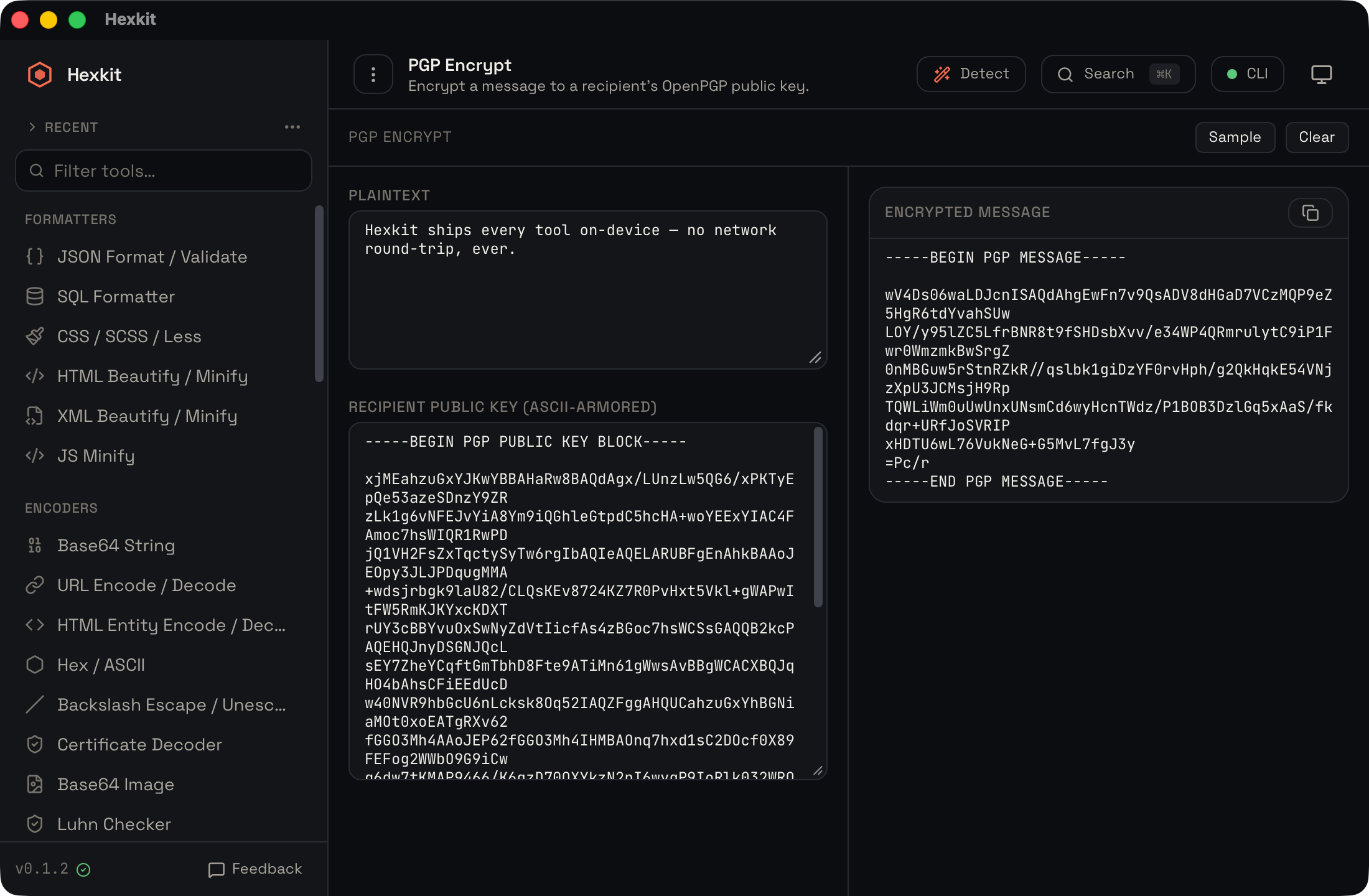
Encrypt a message to a recipient's OpenPGP public key (SEIPDv1 / AES-256).
Also known as: OpenPGP / GPG encrypt.
100% offline · macOS, Windows & Linux · free for personal use
// overview
What it does
PGP encrypt is one of 55 tools in Hexkit, a desktop developer toolbox that runs entirely on your own machine. Encrypt a message to a recipient's OpenPGP public key (SEIPDv1 / AES-256).
Because Hexkit is a native app rather than a web page, anything you paste into the pgp encrypt stays local — there are no uploads, no accounts and no telemetry. You can handle keys, signatures and encrypted messages even with the network turned off, which makes it safe for tokens, keys and production data.
// steps
How to use PGP encrypt
- 1
Open Hexkit and select "PGP encrypt", or press the command-palette key and start typing its name.
- 2
Paste your keys and message. Encrypt a message to a recipient's OpenPGP public key (SEIPDv1 / AES-256).
- 3
Read or copy the result. Everything is computed locally by Hexkit's Rust core, so nothing is ever uploaded.
Tip: the command palette opens any tool in one keystroke.
// faq
Frequently asked questions
- Is PGP encrypt free?
- Yes. PGP encrypt is part of Hexkit, which is free for personal and non-commercial use on macOS, Windows and Linux.
- Does PGP encrypt work offline?
- Completely. Hexkit runs every tool locally with no network access, so PGP encrypt works on a plane or an air-gapped machine.
- Is my data uploaded anywhere?
- No. Hexkit makes no network calls and has no telemetry — whatever you paste stays on your computer.
// keep going
Related tools
Use PGP encrypt without sending your data anywhere.
PGP encrypt ships inside Hexkit — a free, offline developer toolbox for macOS, Windows and Linux. No account, no uploads.